

No one knows your score but you. This is your personal checkpoint.

Future-Ready Training
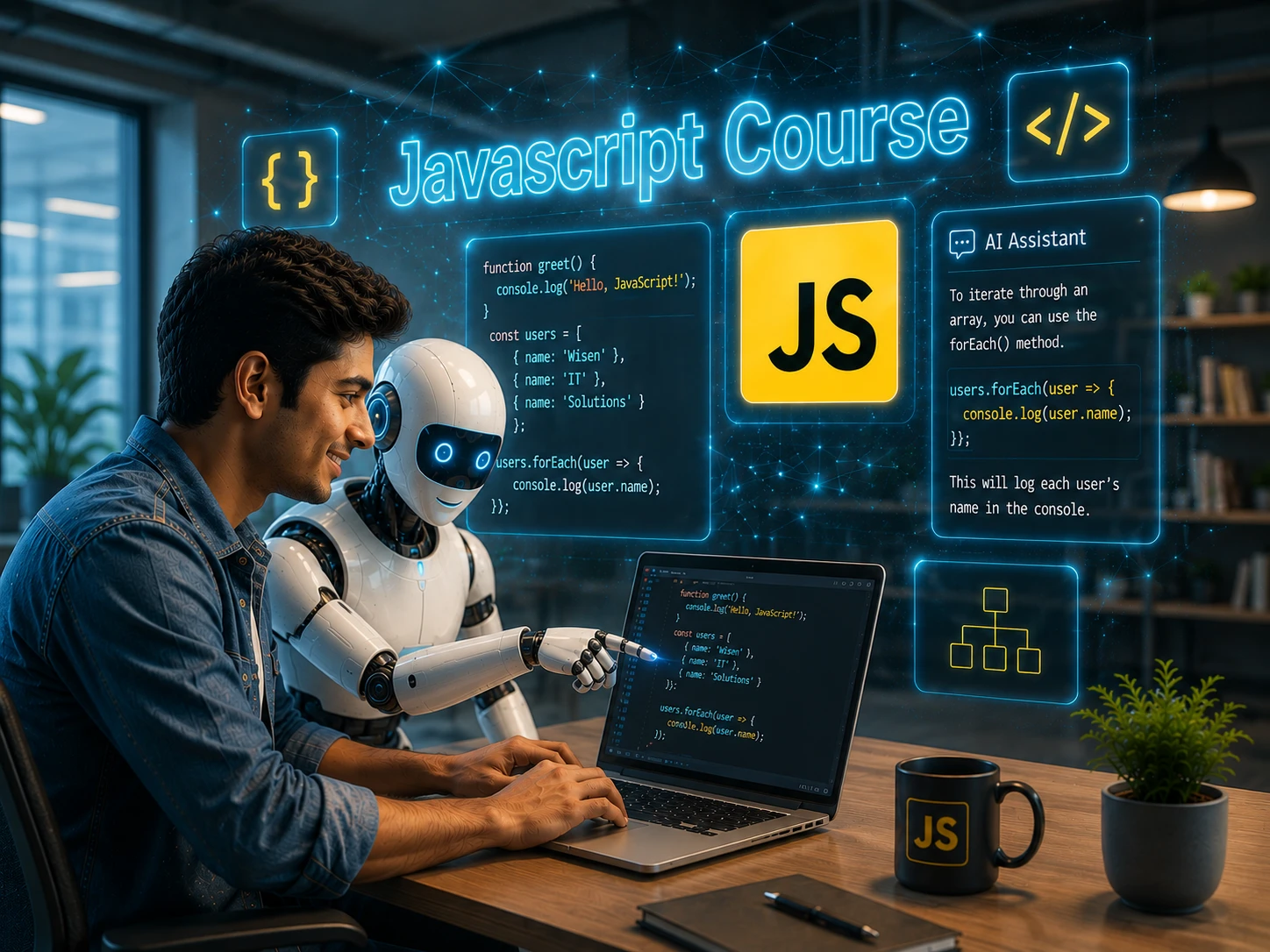
JavaScript Course Built for AI-Assisted Learning
JavaScript Course at Wisen, Chennai, India, builds the language foundation every modern web developer needs. Learn scope, closures, objects, DOM APIs, async JavaScript, modules, debugging and browser workflows through AI-assisted practice, reviewed exercises and project-based JavaScript Online Course training.
“The right JavaScript Online Course today can shape your frontend and full stack career tomorrow.”
2700+ Happy Students/Year
Trusted by 30+ Corporate Clients
17,700+ Learners Trained to Date
27+ Years of Training Excellence
Build an AI-Ready Career
Build a Project-Ready Career
Human thinking leads the work. AI assistance accelerates the practice.
Gain Knowledge. Grow Your Career.
JavaScript Course Syllabus
The course curriculum for JavaScript Course follows a published syllabus with chapter-wise practice, live code review and AI-assisted exercises. It connects JavaScript training with web development workflows, so learners build current tooling confidence, project-ready habits and clear career growth.
Chapter 1Getting Started with JavaScript
Getting Started with JavaScript
This chapter focuses on What JavaScript is and where it runs, A short history: ES5, ES6 and the yearly release cycle, The JavaScript engine, parser and just-in-time compilation and the practice needed to use these concepts confidently in real projects.
- What JavaScript is and where it runs
- A short history: ES5, ES6 and the yearly release cycle
- The JavaScript engine, parser and just-in-time compilation
- Setting up Node.js and a modern editor
- Running scripts in the browser console
- Linking scripts: defer, async and module attributes
- Statements, expressions and semicolon rules
- Comments and self-documenting code
- Strict mode and what it changes
- Declaring variables with let and const
- Why var is avoided in new code
- Naming conventions and readability
- Primitive types: string, number, boolean, null, undefined
- Symbol and BigInt and when they appear
- typeof and its known quirks
- Template literals and string interpolation
- Numbers, floating point precision and Number methods
- Type coercion: implicit versus explicit
- Equality: == against === and Object.is
- Truthy and falsy values
- Nullish coalescing and the logical operators
- Operator precedence and when to add parentheses
- Reading error messages in the console
Chapter 2Control Flow and Functions
Control Flow and Functions
This chapter focuses on if, else if and else, The conditional (ternary) operator, switch statements and fall-through and the practice needed to use these concepts confidently in real projects.
- if, else if and else
- The conditional (ternary) operator
- switch statements and fall-through
- for, while and do…while loops
- for…of and for…in and the difference between them
- break, continue and labelled statements
- Function declarations versus function expressions
- Parameters, arguments and the arguments object
- Default parameter values
- Rest parameters and the spread syntax
- Return values and early returns
- Arrow functions and concise bodies
- Arrow functions and lexical this
- Immediately invoked function expressions
- Pure functions and side effects
- Higher-order functions
- Callbacks and callback signatures
- Recursion and base cases
- Function composition
- Currying and partial application
- Guard clauses over nested conditionals
- Naming functions for intent
Chapter 3Scope, Hoisting and Closures
Scope, Hoisting and Closures
This chapter focuses on Global, function and block scope, The scope chain and identifier resolution, Hoisting of declarations and the practice needed to use these concepts confidently in real projects.
- Global, function and block scope
- The scope chain and identifier resolution
- Hoisting of declarations
- The temporal dead zone
- Shadowing and why it causes bugs
- The execution context and the call stack
- Stack traces and reading them
- What a closure is
- Closures over loop variables
- Private state with closures
- The module pattern
- Memoisation with closures
- Function factories
- Closures and memory retention
- Common closure interview traps
- Lexical environment records
- globalThis and the global object
- Garbage collection basics
- Detecting leaks in the memory panel
- When a closure is the wrong tool
- Debugging scope in DevTools
- Refactoring nested closures for clarity
Chapter 4Objects, Prototypes and Classes
Objects, Prototypes and Classes
This chapter focuses on Object literals and shorthand syntax, Property access: dot and bracket notation, Computed property names and the practice needed to use these concepts confidently in real projects.
- Object literals and shorthand syntax
- Property access: dot and bracket notation
- Computed property names
- Optional chaining on deep objects
- Property descriptors and Object.defineProperty
- Enumerable, writable and configurable flags
- Object.freeze, seal and preventExtensions
- Object.keys, values and entries
- Object spread and Object.assign
- Shallow versus deep copies
- structuredClone for deep copies
- The prototype chain
- Object.create and prototype delegation
- Constructor functions and the new operator
- this binding rules in every call form
- call, apply and bind
- ES class syntax and constructors
- Instance fields and static members
- Private class fields with the hash prefix
- Getters and setters
- Class inheritance with extends and super
- Composition over inheritance
- instanceof and duck typing
Chapter 5Arrays and Collections
Arrays and Collections
This chapter focuses on Creating arrays and array literals, Indexing, length and sparse arrays, push, pop, shift and unshift and the practice needed to use these concepts confidently in real projects.
- Creating arrays and array literals
- Indexing, length and sparse arrays
- push, pop, shift and unshift
- slice against splice
- concat, join and reverse
- indexOf, includes, find and findIndex
- filter for selection
- map for transformation
- reduce and accumulator patterns
- reduceRight and when it matters
- some and every
- flat and flatMap
- sort and comparator functions
- Sorting objects by multiple keys
- Array.from and Array.of
- Destructuring arrays and swapping values
- at() and negative indexing
- Immutable array updates
- Map: keys of any type
- Set and deduplication
- WeakMap and WeakSet for private data
- Choosing between array, Map, Set and plain object
- Grouping and indexing data for fast lookup
Chapter 6Strings, Numbers, Dates and Regular Expressions
Strings, Numbers, Dates and Regular Expressions
This chapter focuses on String immutability and common methods, Searching: indexOf, includes, startsWith, endsWith, Slicing: slice, substring and their differences and the practice needed to use these concepts confidently in real projects.
- String immutability and common methods
- Searching: indexOf, includes, startsWith, endsWith
- Slicing: slice, substring and their differences
- split, trim, padStart and padEnd
- replace and replaceAll
- Case conversion and locale awareness
- Unicode, code points and emoji handling
- Number parsing: parseInt, parseFloat and Number
- toFixed, rounding and money formatting
- Math methods you actually use
- Random numbers and ranges
- Date objects and their pitfalls
- Timestamps, time zones and UTC
- Formatting dates with Intl.DateTimeFormat
- Intl.NumberFormat for currency and units
- Date arithmetic and duration handling
- Regular expression literals and the RegExp object
- Character classes, quantifiers and anchors
- Groups, capture groups and named groups
- Flags: g, i, m, s and u
- match, matchAll, test and exec
- Lookahead and lookbehind
- Validating input safely with regex
Chapter 7Asynchronous JavaScript
Asynchronous JavaScript
This chapter focuses on Synchronous versus asynchronous execution, The call stack, task queue and event loop, Microtasks against macrotasks and the practice needed to use these concepts confidently in real projects.
- Synchronous versus asynchronous execution
- The call stack, task queue and event loop
- Microtasks against macrotasks
- setTimeout, setInterval and clearing them
- queueMicrotask and requestAnimationFrame
- Callback style and callback hell
- The Promise object and its three states
- Creating a promise with the executor
- then, catch and finally
- Chaining promises and returning values
- Error propagation through a chain
- Promise.all and fail-fast behaviour
- Promise.allSettled for partial success
- Promise.race and Promise.any
- async functions and implicit promises
- await and sequencing
- Running awaits in parallel correctly
- try/catch with await
- Async iteration with for await…of
- Async generators
- AbortController and cancelling work
- Timeouts, retries and exponential backoff
- Debouncing and throttling async calls
Chapter 8The DOM and Browser APIs
The DOM and Browser APIs
This chapter focuses on The document object model as a tree, Selecting elements with querySelector and friends, Traversing parents, children and siblings and the practice needed to use these concepts confidently in real projects.
- The document object model as a tree
- Selecting elements with querySelector and friends
- Traversing parents, children and siblings
- Creating, cloning and inserting nodes
- textContent, innerText and innerHTML
- Safely rendering user content
- Working with classList and dataset
- Reading and setting attributes and properties
- Inline styles versus class toggling
- Getting layout: offset, client and scroll metrics
- The event model: capturing and bubbling
- addEventListener and its options
- Event objects, target and currentTarget
- preventDefault and stopPropagation
- Event delegation for dynamic lists
- Keyboard, pointer and touch events
- Form events, validation and FormData
- fetch and the Request/Response objects
- JSON handling and error checking
- CORS in practice
- localStorage, sessionStorage and cookies
- The History API and client-side navigation
- IntersectionObserver, ResizeObserver and MutationObserver
Chapter 9Modules, Tooling and Error Handling
Modules, Tooling and Error Handling
This chapter focuses on Why modules exist: the global scope problem, ES module export and import syntax, Named against default exports and the practice needed to use these concepts confidently in real projects.
- Why modules exist: the global scope problem
- ES module export and import syntax
- Named against default exports
- Dynamic import and code splitting
- Module scope and single evaluation
- CommonJS and interoperability
- Circular dependencies and how to avoid them
- Barrel files and their trade-offs
- npm, package.json and semantic versioning
- Lock files and reproducible installs
- Bundlers: what they do and why
- Transpilation and browser targets
- Source maps and debugging built code
- Linting with ESLint
- Formatting with Prettier
- Editor tooling and type-aware hints
- The Error object and its properties
- throw and custom error classes
- try, catch, finally and rethrowing
- Handling errors at the right layer
- Unhandled rejections and global handlers
- Defensive coding without noise
- Logging that helps future debugging
Chapter 10Testing, Performance and Project Work
Testing, Performance and Project Work
This chapter focuses on Why automated tests change how you refactor, Unit tests, integration tests and the pyramid, Writing a first test with a modern runner and the practice needed to use these concepts confidently in real projects.
- Why automated tests change how you refactor
- Unit tests, integration tests and the pyramid
- Writing a first test with a modern runner
- Arrange, act, assert
- Matchers and useful assertions
- Testing asynchronous code
- Mocks, stubs and spies
- Faking timers and network calls
- Test coverage and what it does not tell you
- Test-driven refactoring in practice
- Measuring performance with the Performance panel
- Reflow, repaint and layout thrashing
- Long tasks and breaking up work
- Efficient DOM updates and batching
- Lazy loading assets and code
- Caching strategies in the browser
- Core Web Vitals and what moves them
- Accessibility checks in the browser
- Project: building the application structure
- Project: data layer and API integration
- Project: state, rendering and interaction
- Project: tests, review and hardening
- Project: build, deploy and walkthrough
Getting Started with JavaScript
This chapter focuses on What JavaScript is and where it runs, A short history: ES5, ES6 and the yearly release cycle, The JavaScript engine, parser and just-in-time compilation and the practice needed to use these concepts confidently in real projects.
- What JavaScript is and where it runs
- A short history: ES5, ES6 and the yearly release cycle
- The JavaScript engine, parser and just-in-time compilation
- Setting up Node.js and a modern editor
- Running scripts in the browser console
- Linking scripts: defer, async and module attributes
- Statements, expressions and semicolon rules
- Comments and self-documenting code
- Strict mode and what it changes
- Declaring variables with let and const
- Why var is avoided in new code
- Naming conventions and readability
- Primitive types: string, number, boolean, null, undefined
- Symbol and BigInt and when they appear
- typeof and its known quirks
- Template literals and string interpolation
- Numbers, floating point precision and Number methods
- Type coercion: implicit versus explicit
- Equality: == against === and Object.is
- Truthy and falsy values
- Nullish coalescing and the logical operators
- Operator precedence and when to add parentheses
- Reading error messages in the console

Upskilling & Induction Programs
Corporate JavaScript Course
Corporate JavaScript course delivery gives your developers the language itself — scope, closures, prototypes, the event loop and asynchronous behaviour — before any framework is introduced. It runs on-site in Chennai or live online, is timed around your sprints, and is practised on reviewed code daily.
Industry-Relevant JavaScript Skills
The ECMAScript core every library on your stack depends on: modules, iterators, promises, error handling and the browser APIs behind them.
AI-Enabled Learning
Work effectively with Claude and AI development tools while human reasoning, engineering judgement and ownership stay at the centre of every JavaScript decision.
Induction & Upskilling Programs
Structured learning paths for new hires, freshers and experienced developers adopting or strengthening JavaScript skills.
Hands-On JavaScript Workflows
Write, debug and refactor real JavaScript — async flows, DOM work, module boundaries and tests — with every exercise reviewed.
Customized Corporate Programs
Align training with your roles, technology stack, delivery timeline, live projects and organisational requirements.
AI-Evaluated Skill Development
Evaluate practical progress through AI-assisted assessments that identify strengths, skill gaps and areas for improvement.
Read. Reason. Ship.
JavaScript Online Course Skills You Gain
Fifteen capabilities you leave with — the language behaviour, asynchronous patterns and debugging habits every framework on your stack already assumes.
Core JavaScript Foundations
Work confidently with types, coercion, scope, hoisting and strict mode, so language behaviour stops being a source of surprises.
Functions, Closures & Scope
Use closures, higher-order functions and lexical scope deliberately to build abstractions that stay small and testable.
Objects & Prototypes
Model data with objects, understand the prototype chain, and know when a class, a factory or a plain object is the right tool.
Arrays & Data Transformation
Shape data with map, filter, reduce and the modern collection APIs instead of hand-rolled loops and mutation.
Asynchronous JavaScript
Compose promises, async and await, and cancellation correctly, and reason about the event loop, microtasks and ordering.
ES Modules & Project Structure
Split an application into ES modules with clear boundaries, and understand how bundlers resolve, tree-shake and split them.
DOM & Event Handling
Query, update and delegate events across the DOM efficiently, and keep interface state and markup in step.
Fetching & Working with APIs
Call HTTP APIs with fetch, handle status codes, aborts, retries and JSON edge cases, and surface failures to the user.
Error Handling Patterns
Throw, catch and propagate errors deliberately, distinguish expected failures from bugs, and keep the application recoverable.
Runtime Performance
Profile hot paths, reduce layout thrash, debounce expensive work, and measure the result rather than guessing.
Testing JavaScript
Write unit and integration tests, mock boundaries, and design code that is straightforward to test in the first place.
Debugging & Dev Tools
Read stack traces, set breakpoints, inspect scope and network traffic, and narrow a defect to its actual cause.
Modern Tooling
Work with npm, bundlers, linters and formatters as part of a normal day, not as configuration you copy and hope for.
Client-Side Security
Recognise XSS, injection and unsafe storage patterns, and apply escaping, CSP and token handling that hold up in review.
AI-Assisted Development
Use Claude and Claude Code to explore, implement and review JavaScript while your own engineering judgement stays in charge.
How the verification works
How you verify your JavaScript skills independently
Most training providers set their own test and mark their own paper. We do not. At the end of each stage of the JavaScript Course you check your own readiness using your own ChatGPT, Claude, Gemini or other AI account. Wisen does not write the questions, does not see your answers, and does not record your score.
The reasoning is straightforward. A score we control proves very little — to an employer, or to you. A score produced by a tool we have no influence over is worth something. You ask the AI to test you on JavaScript, it decides what to ask, and the result belongs to you alone.
Seventy per cent is the mark we treat as ready. Score seventy or above and you move on to the next stage. Score below it and we work through the gap with you: identify what was missed, teach it again, practise it, then go back to the AI and check. You repeat that loop as many times as it takes.
In short
- You use your own AI account, not one of ours.
- We do not write the questions and cannot influence them.
- Your score stays private — we never see it.
- Below seventy per cent, we work through the gap with you and you verify again.
Our Unique Promise
Independent AIVerification Checkpoint
You learn JavaScript Course. AI verifies. Wisen helps you grow beyond 70%.
Use ChatGPT, Claude, or another AI tool to validate your JavaScript Course readiness.
It is your learning journey. Go at your pace.
Every step you take today builds your tomorrow.
Our mission is your growth, always.
Placement Assistance
Career Support You Can Count On
The JavaScript course is built to make you employable, not to promise you a job. We do not guarantee placement — we give you the depth, the profile and the guidance to go and earn one.
- 01
Gain 2+ Years of Professional Knowledge
You leave knowing why JavaScript behaves the way it does — scope, closures, the event loop — which is the depth an interviewer expects from someone already two years into the work.
- 02
Resume / Biodata Support
Get expert guidance to build a strong, professional resume that highlights your skills, projects and achievements.
- 03
Portfolio Development
Build real-world projects and a strong portfolio that demonstrates your practical skills to potential employers.
- 04
Interview Preparation
We rehearse the questions JavaScript interviews actually turn on: asynchronous ordering, how ‘this’ binds, and reading a snippet aloud and predicting its output. You get feedback after every mock round.
- 05
Job Search Guidance
We show you which roles a JavaScript developer should apply to first, how to read a job description honestly, and how to approach openings that are not advertised.
- 06
Placement Assistance
We assist you in identifying relevant opportunities and connecting with potential employers.
- 07
Independent AI Verification Checkpoint
Your learning, projects and skills are verified by our Independent AI Verification System to ensure objective and unbiased evaluation.
- 08
Future-Ready Knowledge
The language moves every year and the material moves with it, so what you learn holds up through the next several ECMAScript releases rather than expiring with your batch.
Our Commitment
We do not place you and we will not pretend otherwise. What happens next depends on your practice, your assessment results and what employers are hiring for. Our part is to keep helping — reviews, references and answers — long after the batch closes.
Learn. Practice. Master JavaScript.
Chennai JavaScript Course Materials

Every participant on the JavaScript course in Chennai receives a complete set of written material, not a slide deck. Notes explain how the language actually behaves, lab activities carry one change from plan to verification, and exercises put the same idea on a codebase you have not seen before. Everything is written in-house by trainers who ship JavaScript, and revised as the language and its tooling move.
What You Will Receive
JavaScript Notes & Explanations
Explanations of scope, closures, prototypes, modules, the event loop and asynchronous patterns, written for practising developers rather than copied from documentation.
Guided Lab Activities
Labs that carry one change through planning, implementation and verification — a small application wired to a real HTTP API among them.
Hands-On Exercises
Independent tasks on refactoring, debugging, writing tests and reviewing diffs, worked without a walkthrough to lean on.
Worked Walkthroughs
Recorded sessions showing project setup, the change itself, and the checks that prove it works.
Progressive Learning Path
A route from the fundamentals to asynchronous work, modules and tested browser applications, in the order the live sessions follow.
Revision & Reference Sheets
Compact references for language behaviour, array and promise APIs, and debugging steps, plus the review habits that keep AI-assisted work safe.
What Makes Our JavaScript Learning Materials Different?
27+ Years of Experience
Authored by trainers who weigh every JavaScript decision against decades of delivered software.
Human-Authored Content
Written by trainers who work with JavaScript daily, then reviewed line by line.
Original Learning Materials
Created in-house, not assembled from documentation or shared prompt collections.
Practice First
Every technique is applied to a real JavaScript task and its result inspected.
Continuously Refined
Revised as JavaScript and developer tooling move, so sessions reflect what works this month.
Review Discipline Built In
Materials teach reading the diff and testing the change, not accepting output on trust.
Plan. Attend. Practise.
JavaScript Course Duration & Batch Timings
JavaScript Course from Wisen IT Solutions, Chennai runs live in two paces over 60 Hrs of instructor-led training. The lecture and practical time is split 50 : 50, with the practical half weighted towards writing, debugging and reviewing JavaScript in the room.
Total Learning Hours
60 Hrs
Lecture : Practical
50 : 50
Batches
Weekday & Weekend
- Instructor-led sessions
- Guided lab activities
- Hands-on JavaScript practice
- Reviewed project work
Normal Track
2.5 Hours / Session
24 sessions · about 5 weeks
A steady pace for developers taking JavaScript training alongside a full working day.
- Working Developers
- College Students
- Team Leads
- Weekend Batches
Fast Track
5 Hours / Session
12 sessions · about 3 weeks
A concentrated schedule through the same JavaScript syllabus for learners free on weekdays.
- Full-Time Learners
- Job Seekers
- Fresh Graduates
- Career Switchers
What Every Seat Includes
- Live instructor-led sessions
- Hands-on JavaScript coding
- Guided lab activities
- Independent exercises
- AI-assisted learning
- Code review and feedback
- Doubt clarification
- Certificate on completion
Same Syllabus · Same Labs · Same Evaluation · Same Outcome
Whichever batch of the JavaScript Course you join, the syllabus, lab activities, exercises and evaluation are identical. Only the pace differs, so pick the track that fits the time you can genuinely give it each week.
Live online, worldwide
Join JavaScript Course from anywhere in the world
Every session is taught live by a practising engineer — never a pre-recorded video. Batches run to Indian Standard Time, and the timing is adjusted to suit your time zone wherever you are.
Live, not recorded
You write code during the session, ask questions as they come up, and have that code reviewed.
Your time zone, any country
Weekday and weekend slots in IST. If none of them suit where you live, we schedule a batch that does.
Pay from outside India
International debit and credit cards, PayPal and direct bank transfer are all accepted.
Balanced Learning. Real Practice. Career-Ready Skills.
JavaScript Lecture-Practical Ratio
JavaScript is a practice, not a subject to read about. The JavaScript Course is delivered on a 50 : 50 lecture-practical ratio, so every concept is applied in the same session it is explained, on code that behaves like the code you will be paid to write.
Sessions are spent writing, breaking and repairing JavaScript with a trainer watching — which is what delivery work and technical interviews actually ask for, rather than a description of it.
50%Theory
50%Practical
50% Theory
Where each JavaScript idea comes from, and when it is the right one to reach for.
- Getting Started with JavaScript
- Scope, Hoisting and Closures
- Arrays and Collections
- Strings, Numbers, Dates and Regular Expressions
- The DOM and Browser APIs
- Testing, Performance and Project Work
50% Practical
What you do with it, in the same session, on code that behaves like production.
- Live coding in the browser console and editor
- Refactoring callback code to async and await
- Debugging with breakpoints and the call stack
- Consuming a real HTTP API with error handling
- Writing unit tests for the code just written
- Reviewing a peer diff before it is accepted
Why a 50 : 50 Split Works for JavaScript
See It Work First
Each idea is demonstrated running before you are asked to build with it.
Build It Immediately
Every concept becomes JavaScript code you write while it is still fresh.
Work on Real Code
Practice happens on realistic repositories, not on disposable snippets.
Fail Where It Is Safe
Break it in the room, where a trainer can explain what actually went wrong.
Prove the Skill
Leave able to demonstrate the work, not only to talk about it.
Our Learning Philosophy
Every JavaScript concept is followed by something you build yourself.
Clear Entry Bar. No Guesswork. Career-Ready Start.
JavaScript Course Prerequisites
This JavaScript Course starts at the language itself, so no programming background is assumed. Variables, functions, objects, the DOM, asynchronous work and modules are all introduced from the first session.
The JavaScript Course is delivered live online and in Chennai, so everyone starts the same exercises from the same baseline.
Basic ComputerLiteracy
- Comfort installing software on your own laptop
- Reading English technical documentation
- HTML structure and basic CSS — revised in class
- Running commands in a terminal — covered if new
EngineeringDiscipline
- Willingness to review every change you write
- Care with credentials and private repositories
- Habit of describing a defect precisely
- Commitment to the hands-on JavaScript Course builds
JavaScript WorkspaceSetup
- A laptop with a stable internet connection
- Node.js and npm — setup guidance provided
- VS Code plus a working terminal
- A modern browser with developer tools
Who Can Join?
- Students & Graduates
- Students & Career Switchers
- Tech Leads & Architects
- Teams standardising on modern JavaScript
The Language. The Runtime. The Toolchain.
JavaScript Course Tools & Technologies
The JavaScript Course is taught inside the tools the work actually happens in. JavaScript is taught in the runtime you will actually ship to — Node.js and npm at the terminal, Chrome DevTools open beside the editor and the event loop traced on running code.
You leave able to read and write modern JavaScript without a framework hiding it from you. Every tool listed below is used in the sessions rather than only named in them.
Language Core
- Types & Coercion
- Functions & Closures
- Objects & Prototypes
- ES Modules
- Iterators & Generators
- Destructuring & Spread
Async & Data
- Promises
- async / await
- Fetch API
- The Event Loop
- JSON & Web Storage
- Array Methods
Browser & DOM
- DOM API
- Event Handling
- History & Routing
- Template Literals
- Chrome DevTools
- CORS & Same-Origin
Tooling & Quality
- Node.js & npm
- VS Code
- ESLint & Prettier
- Vite Bundling
- Jest
- Git Workflow
Learning Outcome
You finish the JavaScript Course able to write modern JavaScript that runs in the browser and on the server — through project work you can defend in review.
- Command the Language
- Handle Async Work
- Drive the DOM
- Test What You Write
Primary Sources
JavaScript Course Official References
The syllabus follows the language as it is specified and documented, not as a tutorial retells it. These are the sources we teach from and check against.
- MDN Web Docs — JavaScript
Mozilla’s language reference for the syntax, the built-ins and the runtime semantics taught in the syllabus.
- ECMA-262 — the ECMAScript specification
The standard itself, published by TC39 — the final word on how the language behaves.
Got Questions - Quick Answers
JavaScript Course — frequently asked questions
Is there real hiring demand for the JavaScript Course skills in Chennai?
Product companies, global capability centres and services firms in Chennai all run teams on this stack, which keeps steady demand behind the JavaScript Course. Because the JavaScript Course in Chennai is used for new builds and for long-lived applications alike, that demand spans startups and established engineering organisations.
Can freshers and non-IT graduates join this training program?
Yes. Freshers and graduates from non-IT streams join regularly, and this training program starts from the fundamentals before moving into advanced work. If your programming basics are thin we will say so before you enrol, and suggest the order in which to take the JavaScript Online Course and its prerequisites.
What is the refund policy if I enrol in the JavaScript Course?
We run a one-week evaluation instead of a one-hour demo class. A ₹2,000 registration fee reserves your seat in the JavaScript Course; attend the first week of live sessions and, if the training is not the right fit, that registration fee is refunded in full. If you register but cannot attend, it converts to Training Credit valid for 12 months. Once the course fee is paid, this training program fees are transferable once, within a month, if you leave before two weeks, and are neither refundable nor transferable after two weeks of attendance.
What placement support do I get with the JavaScript Online Course?
We do not promise a job, and you should be wary of anyone who does. What the JavaScript Online Course includes is preparation: we help you prepare your biodata, build a portfolio from work you have actually done, and identify the knowledge gaps that would cost you an interview. That review covers the the JavaScript Course skills interviewers ask about today and the ones worth learning next, so you can keep preparing after the course ends.
Do I need programming experience before joining the JavaScript Course?
No prior JavaScript experience is required. You should be comfortable with basic HTML and CSS. The course begins with the language core and builds up to asynchronous programming and browser APIs.
How long is the JavaScript Course and how is it scheduled?
The course covers 60 hours of instruction. Weekday evening and weekend batches are available, delivered live online.
Will I build real projects during the course?
Yes. You build a complete application incrementally across the course, and every module includes hands-on exercises reviewed by the trainer.
Is a certificate provided on completion?
Wisen IT Solutions, Chennai issues a course completion certificate once you finish the assessments and the final project.
- 27+
- Years of training
Delivering technical training from Chennai since 1996. - 17,700+
- Learners empowered through training
Corporate teams, IT working professionals, career switchers and students. - 2,700+
- Happy students / year
Learners completing our programmes every year. - 30+
- Corporate clients
Product companies, service firms and startups.
Corporate training clients
Teams that train with Wisen IT Solutions, Chennai, India
Engineering teams across product companies, IT services firms and startups run their JavaScript, Angular, React and Next.js upskilling and induction programs with us.

Altimetrik 
Aparajitha Corporate Services 
Caresoft 
Dzine Hub 
Firstsource 
Gigamon 
Helios and Matheson 
NextGen Healthcare 
Perpetuuiti Technosoft 
R Systems 
SRM Institute of Science and Technology 
Temenos 
The Hindu 
Tamil Nadu Electricity Board 
WABCO

Build JavaScript for the AI-era
Plan your JavaScript training with Wisen IT Solutions, India
Tell us where you are today — a beginner, a working developer, or a team with a delivery deadline — and we will map the right course, format and schedule.
Think with AI. Don't Depend on AI.